

Every company, whether large or small, needs to build an email list in order to survive and grow in highly competitive online markets. This is exactly why targeted email communication is essential.
An email list also provides additional security during times when, for example, a traffic source breaks down or target audiences are difficult to reach during certain seasons, such as the holiday season. But there are many more benefits, as this article will show.
Why should you build your own email list?
The first reason for building your own email list directly relates to revenue. It is very difficult not to increase sales by using a newsletter. Most companies that use email marketing experience a noticeable increase in sales.
Every company that uses email marketing can expect increasing revenues — regardless of the industry.
That's right: when a newsletter is sent to your own list, you would have to do a lot wrong to fail to generate additional revenue.
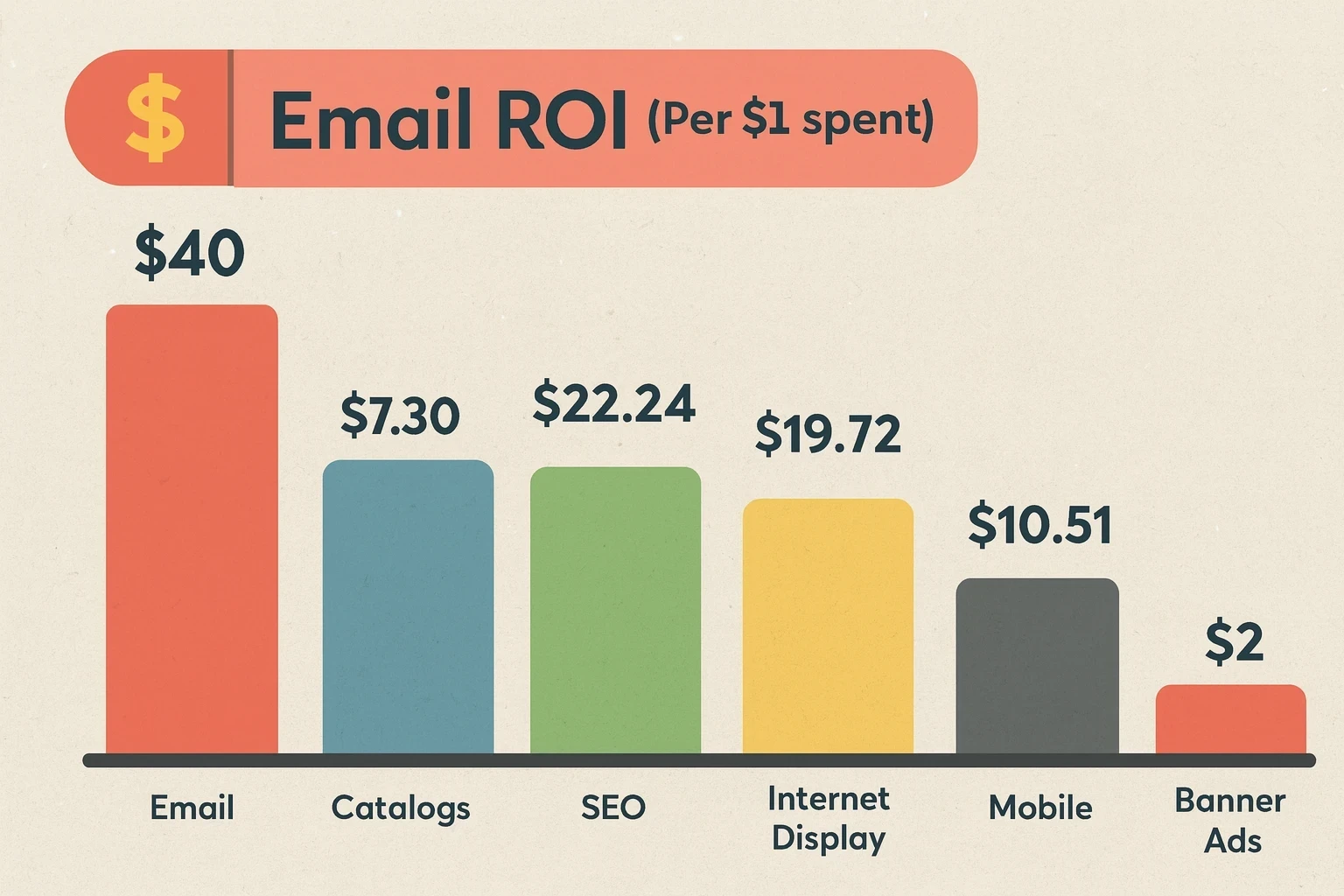
Today, an email list is the greatest lever to generate revenue almost at the "push of a button." Email marketing is therefore significantly more effective for customer acquisition than search engines or social networks.
The following statistic shows how much more effective email is as an advertising medium:
Another important aspect is trust.
Typically, around seven interactions with a potential customer are required to build enough trust in a brand or product to trigger a purchase.
With website visitors from search engines or social networks, it usually isn't possible to make a sale on the first contact. The traffic is often simply too cold.
The most important reason for building your own email list, however, is the ability to generate traffic at the push of a button and bring potential buyers back to the website — especially if it is an online shop.
If a website is built that depends solely on Google or another single traffic source, there is a significant risk. If that traffic source fails, revenue will collapse as well.
A website that previously generated €1,000 or even €10,000 per month or more could suddenly generate no revenue at all.
However, if you have a high-quality email list with active recipients, this cannot happen because contacts can always be reached again via email.
Those who have their own email list possess one of the most valuable direct accesses to potential customers.
After this brief introduction to the reasons for building your own email contact list, it is worth looking at the individual steps to quickly build a high-quality email list.
Step 1: The right email marketing software
First, software is needed to send newsletters and marketing emails. You can either use your own software, for example a PHP newsletter software installed on your web hosting, or an external service.
Beginners often make the mistake of using cheap or free email tools for commercial email sending or even handling it through local email programs, for example, using Thunderbird to send newsletters.
In both cases, significant technical problems and legal risks can arise, which are often associated with mass sending of commercial emails.
A larger email list cannot be effectively built or managed if recipients are stored locally on your own computer. In addition, legal requirements must always be observed for commercial email sending, for example:
- Consent of recipients (Double Opt-in)
- Compliance with GDPR, especially regarding data storage and processing
- Observance of the UWG (Law against Unfair Competition)
- Option to unsubscribe at any time from email communication
- Complete and correct imprint (Impressum)
- Documentation of consents for proof purposes
If legal requirements are not followed or there are gaps in documenting registrations, so that individual consents cannot be fully traced and proven, significant fines may be imposed.
It must always be possible to prove that the email list was built independently and based on explicit consent from the recipients, and not obtained from unofficial or illegal sources. Unfortunately, many companies — especially unscrupulous providers — still resort to purchasing email addresses.
Professional email senders therefore rely on email marketing solutions that cover both technology and legal security.
If you want to target international users with your email marketing campaigns, and also need high deliverability and reliability at reasonable pricing, the following providers are the perfect fit:
- GetResponse — one of the first providers for professional email marketing. Starting with simple newsletter services, it is now a complete suite of marketing tools for any company size.
- AWeber — a very mature and easy to use email marketing service provider. Send newsletters, follow-up autoresponders, or use automation — everything for a reasonable price.
- MailChimp — probably the most modern and easy to use email marketing software out there. Great user interface, deep analytical data on each email, and attractive pricing.
All of these providers meet all legal requirements for professional mass sending of commercial emails and have solid, mature technology to ensure that emails reach their destination.
In addition, they offer detailed statistics on the performance of each individual email campaign, so that the sender can always track how a newsletter or marketing email is performing and make adjustments and optimizations to their email marketing.
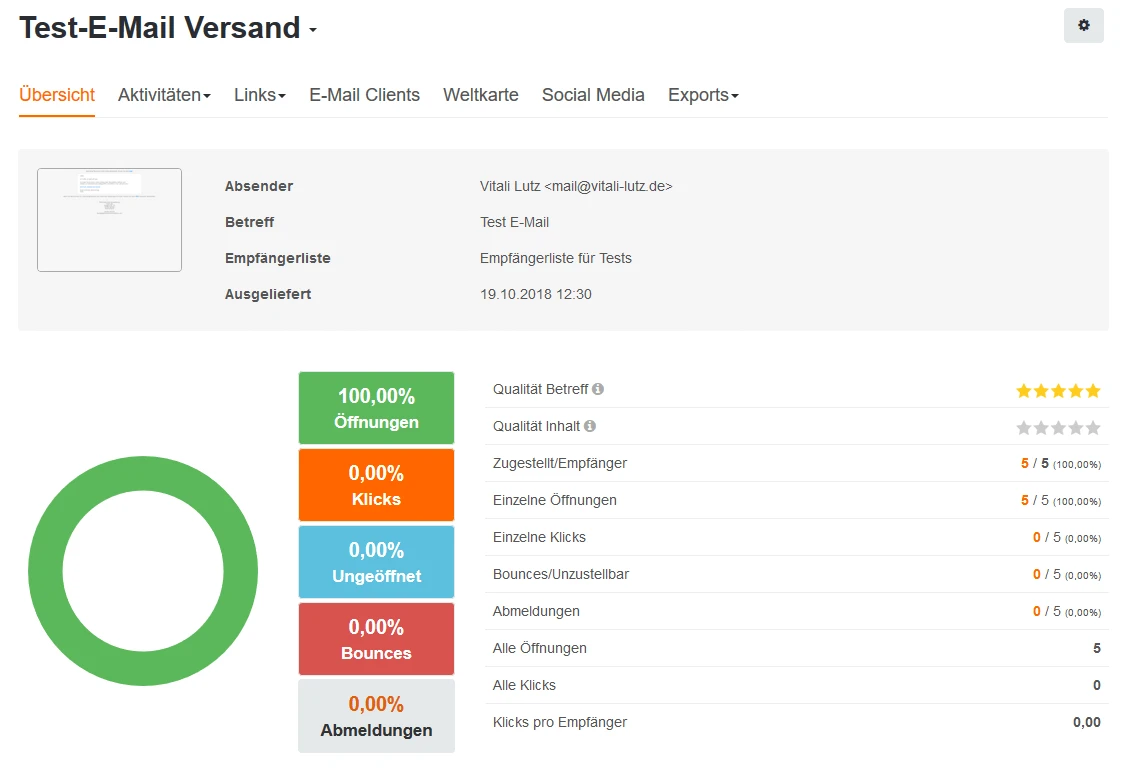
As can be seen in the figure above, detailed statistics are available for every sent email or newsletter regarding opens, clicks, unsubscribes, complaints, and much more. Such features are not to be expected from free software. These are professional features for successful email marketing.
Especially with large lists of several hundred or thousands of recipients, manual sending is no longer practical. Without powerful software, the time required would simply be too high to work economically.
Step 2: The email signup form
To build an email list, the use of an email signup form is required. This form is usually provided by the software or service used to implement email marketing. The signup form typically asks interested parties for their name and email address.
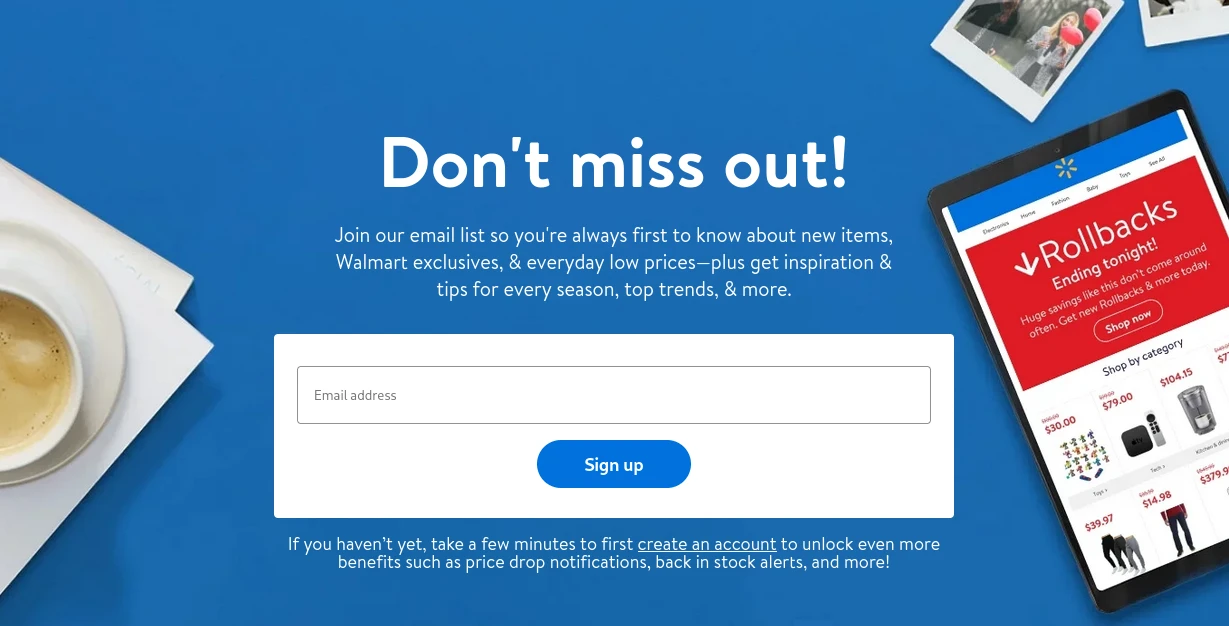
As the example form above shows, the advantages of signing up are clearly visible. It is a very well-implemented simple newsletter signup form that is likely to generate many interested parties and newsletter recipients.
The less input fields you add to the form, the more signups you will get. People don't like to fill out too many fields when signing up. Keep it as simple as possible and don't ask for data you won't need anyway.
Today, in very few industries do interested parties voluntarily enter their email address into a form without receiving a tangible benefit in return. For this reason, it has become common to offer a clear benefit to the subscriber — often in the form of a "gift".
This can take many forms, for example:
- a eBook or guide
- a Whitepaper or checklist
- a discount or voucher
- access to exclusive content
- a webinar, video, or online training
- a free template or tool
Such incentives for signing up can dramatically increase the signup rate. However, one should not overdo it and build a list of people who sign up only because of the gift and have no real interest in the email service.
This would lead to a low-quality list consisting of recipients with little or no purchasing power.
In practice, a 7-day course or a free eBook is often used. Such content can be created quickly and still works very well today for building email lists.
For online shops, vouchers work particularly well since almost everyone wants to save when shopping. In consulting industries, free advice via email or phone is usually the most effective incentive.
It is important that the promised gift is delivered immediately after signing up and is truly free. Unexpected obstacles or hidden conditions quickly lead to frustration and unsubscribes.
To collect email addresses, a form is embedded in the website. After creating the form in the email marketing software, you receive an HTML code that must be integrated into the website. When the webpage is loaded, the functional signup form is automatically displayed at this location.
Suitable placements include:
- Homepage / Hero section — immediately visible when the page loads
- Blog posts / Content pages — relevant to the topic
- Sidebar or footer — present on all pages but unobtrusive
- Pop-ups or slide-ins — triggered by time or behavior
- Landing pages for special offers — focused on a clear benefit
Placement in the sidebar or below articles has proven effective. The forms are present but not intrusive, and still achieve good signup numbers.
Step 3: First emails and building trust
The real work begins once someone has signed up to the email list.
- Write and send emails with added value on a regular basis
- Show readers that you care about them, which builds trust in the brand
This ensures a loyal and growing email list with readers who regularly open emails, read them, click links, and thus contribute to revenue as effectively as possible.
New subscribers initially do not know the sender and therefore bring little trust. However, this trust is crucial and often develops over several weeks or months.
Trust is built through useful, transparent, and honest content that is sent regularly via email. Anyone serious about email marketing should not hide.
It should be noted that trust begins as soon as contact information is disclosed. Every email must include the sender's name and address. This information must be directly visible and integrated into the email. A link to an external page is not sufficient!
A clear sender information are essential and are often placed in the email footer. Anonymous or foreign addresses tend to discourage trust and are not suitable for building it. Additionally, anonymization is prohibited in most countries when it comes to bulk mailing.
Also important is the balance between informative and promotional emails. A simple rule has proven effective: at least four informative newsletters before sending a promotional email. This ratio ensures recipients are not annoyed by too frequent advertising and stay on the list long-term.
This rule does not apply to newsletters subscribed to for product offers. If readers explicitly want product information via email, then of course every email will provide this content. For example, Amazon does this, presenting relevant product offers in every email.
Step 4: Monetizing the email list
Monetization also plays an important role in building an email list. After all, the time and effort invested must pay off in the long run.
Commercial newsletters and marketing campaigns that do not generate revenue are like a car that cannot move.
High-quality content builds trust. Eventually, there comes a time when this trust can be converted into revenue.
It is recommended to send new subscribers only valuable content for at least one to two weeks before presenting any offers. This process is called warming up cold contacts. This approach has proven very effective for purely informational offers, such as eBooks or video courses.
Again, the rule applies: email lists containing potential customers who have signed up in a product shop usually do not require a "warm-up phase." The recipients have already shown interest in the products and can be targeted with relevant offers from day one.
Warming up fresh contacts can be easily implemented using automated follow-up emails. These are sent automatically to new recipients at fixed time intervals.
- On the first day, the reader receives a welcome email with a gift, e.g., a coupon code
- On the second day, the first email with high-quality, relevant content
- On the third day, more value addressing the readers' pain points
- …
- On the sixth or seventh day, the email series transitions to product introduction
Follow-up is a very powerful strategy. It allows email marketing to be fully automated, run on autopilot, and generate continuous revenue.
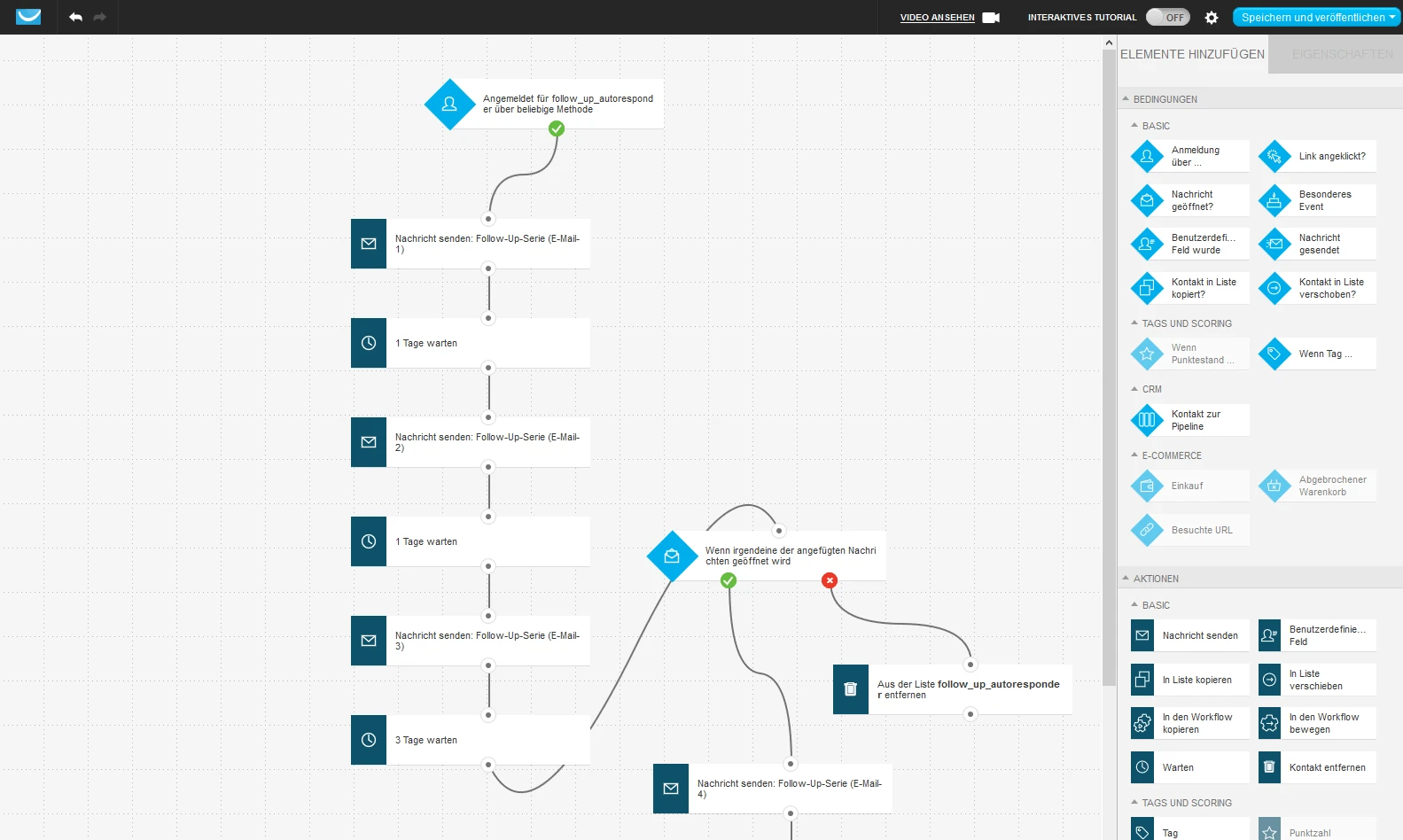
Monetization can therefore be carried out specifically through automated email series. This is a major advantage of using professional email marketing providers: they offer highly advanced automation of email campaigns.
For monetization, both own products and affiliate products are possible. Since not everyone offers their own products, affiliate offers are the easiest entry point for many.
It is important that the respective affiliate program explicitly allows email marketing. For example, Amazon prohibits promoting its products via email and may suspend the partner account in case of violations.
Digital products such as eBooks, video courses, webinars, or software are particularly suitable, as email marketing is generally allowed for these.
Key considerations for long-term list building
For long-term success in email marketing, there are some fundamental principles that should always be observed:
- Double opt-in: Confirm sign-ups
- Value before promotion: Provide useful content first
- Email software: Use tools that support growth and automation
- Right tone: Address the target audience appropriately
- Transparency: Be clear about content and data usage
- Simplicity: Keep sign-ups and emails easy to understand
- Monitor unsubscribes: Make it easy to unsubscribe, track rates
- Analyze statistics: Use open and click rates for optimization
These points form the foundation for successful and sustainable email marketing – just as I personally practice and recommend to my service clients.
Conclusion
The most valuable asset in an online business is your own email list of prospects and customers who enjoy consuming your email content and eagerly anticipate new emails or newsletters. This foundation is priceless for any company.
It is not solely about selling.
Especially in information-based industries, high-quality and useful content is crucial for establishing expert status and building trust.
In other industries, such as e-commerce, product presentations and special offers can also be perceived as relevant information.
As long as the content meets the needs and expectations of readers, email marketing is one of the most effective tools in any online business.