


A newsletter is often sent to hundreds or even thousands of readers. Naturally, not all recipients read the newsletter at the same time. In the worst case, it sits in the inbox for several hours or even days and is pushed down by newer emails.
One of the most important factors for achieving a maximum open rate is the sending time. If this is chosen incorrectly, a newsletter campaign can never reach its full potential.
The problem with spam and crowded email inboxes
Statistics show that an average email recipient today receives 20 to 40 or even more new emails per day. The real problem is that the majority of these messages are never opened and therefore never read.
If emails are checked only once a day in the evening and a message arrives at 6:00 a.m., the evening inbox often contains 20 or more unread emails. In this flood of messages, a single email is easily overlooked.
So how likely is it that all of these emails will actually be read?
Very unlikely — simply due to time constraints.
Most emails are pre-sorted based on subject line, sender name, and perceived urgency. Anything that does not appear immediately relevant is often deleted right away.
For successful newsletter campaigns, it is therefore crucial to send messages exactly when recipients are actively reading their emails.
Those who read emails in the morning should also find the newsletter in their inbox in the morning. The same applies to midday or evening — the sending time must match reading habits.
Choosing the right time is extremely important in order to achieve the highest possible open and click-through rates.
The "best" sending time is always individual
Each recipient reads emails at a different time.
This may be in the morning, at noon, in the evening, or somewhere in between. Consequently, the sending time would ideally be defined individually for every newsletter reader.
But how can this work when a mailing list consists of thousands of contacts?
Without technical support, this is impossible. In traditional bulk sending, the process usually looks like this:
- A new newsletter is created
- A fixed date and time are defined
- The software sends the newsletter to the entire list at exactly this time
This leaves one central question unanswered:
How can the sending time be set individually for each recipient?
Only the newsletter software itself knows the optimal individual sending time. This is because it tracks when recipients interact with emails — when they open them and click on links.
At this point, it is important to use software that is capable of tracking email opens and clicks and determining the best sending time for each recipient. Such professional features are usually not available for free.
The newsletter software knows the best sending time
The easiest way to determine the best sending time is to leave this task to the newsletter software. If the software only allows a fixed sending time, this is a disadvantage — but not an unsolvable one.
Many well-known newsletter solutions do not offer true dynamic sending times. Instead, only a fixed date and time can be defined.
The following chart illustrates what an optimal sending time can look like:
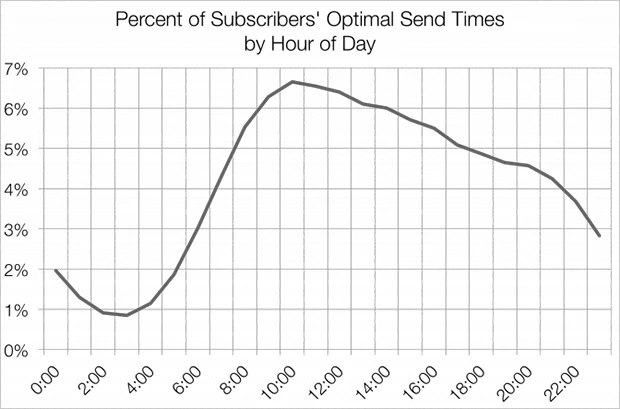
This statistic comes from the newsletter software Mailchimp. It clearly shows that the optimal sending time for this mailing list lies between 10 a.m. and 6 p.m., ideally between 10 a.m. and 2 p.m.
Sending newsletters within this time window significantly increases the chances of achieving the highest open rates and maximizing revenue generated through newsletters.
Having access to such statistics is a decisive advantage when building successful newsletter campaigns.
If the newsletter software in use supports a dynamic, individual sending time per recipient, these campaigns are usually far more successful than those sent at the wrong time.
Using the time of most opens as the sending time
Modern newsletter software provides very detailed statistics today. This includes information on the time of day when the highest open rates occur, as seen above. Some professional email services go to great lengths when it comes to in-depth analytics.
The time shown by the newsletter software at which the most interactions occur is a solid starting point. This time minus 30 to 60 minutes is considered an especially effective sending time.
Why minus 30 to 60 minutes?
The actual delivery process can be delayed by minutes or even hours. This depends on the size of the email list and the current load on the email service's mail servers.
It is always advisable to allow at least 30 minutes for full delivery.
After the first campaigns sent to a fresh list, the statistics clearly reveal the time windows in which most opens occur. This time is ideal for future newsletters sent to the same list.
The following chart shows the times of day when emails are opened most frequently:
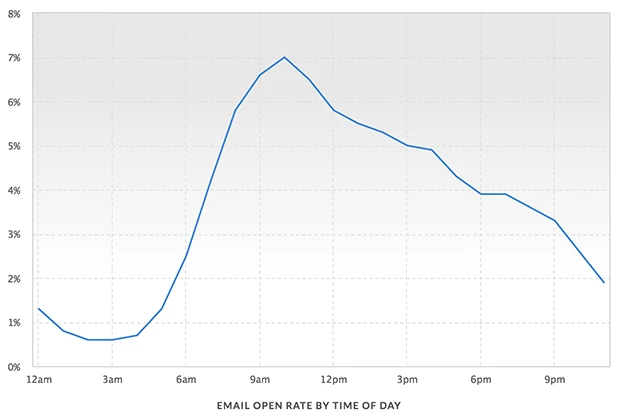
This information is extremely valuable for placing newsletters in inboxes at the optimal time.
Conclusion
Knowing the optimal sending time for a mailing list is one of the greatest advantages in email marketing.
Most emails that are opened and read today arrive precisely when recipients are actively checking their inboxes. At that moment, full attention is available.
If an email instead gets lost among many other senders, the likelihood of it being read drops significantly. This is exactly what happens when the sending time is set incorrectly or not considered at all.
Serious newsletter marketers leave nothing to chance. When an email campaign performs well, it is not due to luck, but to a well-thought-out strategy.
Anyone looking to improve just one factor to increase a newsletter's open rate should focus on knowing the optimal sending time for their mailing lists.
For this purpose, it is worth taking a close look at email statistics. They clearly show the times at which emails are most frequently opened and clicked.
Ideally, a newsletter software automatically determines the sending time and sets it individually for each recipient. In this case, newsletters are almost always delivered "on time" to recipients' inboxes.